Thy Chapter Explained: James Chapter 2 Verses 1-13
Greetings fellow Bible readers and studiers of the Word! We continue this series of the book of James by diving into chapter 2.
But first, a quick review of chapter 1: The first part outlines how the trials of life are actually a blessing, and we should embrace them rather than complain about them. Additionally, James gave us instructions to be not only readers of the word but doers, essentially acting as the good Bible tells us to.
Now, onward…
James continues in his instruction to us; I think you’re understanding the essence of the entire book by now.
Verses 1 “My brethren, have not the faith of our Lord Jesus Christ, the Lord of glory, with respect of persons.”
If you’re reading and re-reading this verse, and scratching your head, you’re definitely not alone. I was right there with you. Is he saying if we want to be like Jesus, we shouldn’t respect people? Or if don’t have faith then we respect people? Or is it that we are not to have faith in regards to people? This is where I learned a very important lesson when reading the Bible: CONTINUE READING. Many “feel good” verses are printed on shirts, notebooks, cups, or made into online posts. I’m not saying this is a bad thing; it’s a great way to spread the Word of God. However, many are taken out of context, which results in the point God was trying to make being lost. This first verse of the chapter makes my point. So, taking my own strong advice, lets keep reading:
Verse 2-4: “2 For if there come unto your assembly a man with a gold ring, in goodly apparel, and there come in also a poor man in vile raiment;
3 And ye have respect to him that weareth the gay clothing, and say unto him, Sit thou here in a good place; and say to the poor, Stand thou there, or sit here under my footstool:
4 Are ye not then partial in yourselves, and are become judges of evil thoughts?”
Unto your assembly: refers to a gathering or congregation
Raiment: clothing
Gay clothing: refers to bright, splendid, or luxurious garments that signify wealth and social status
Under my footstool: refers to a position of low status or servitude
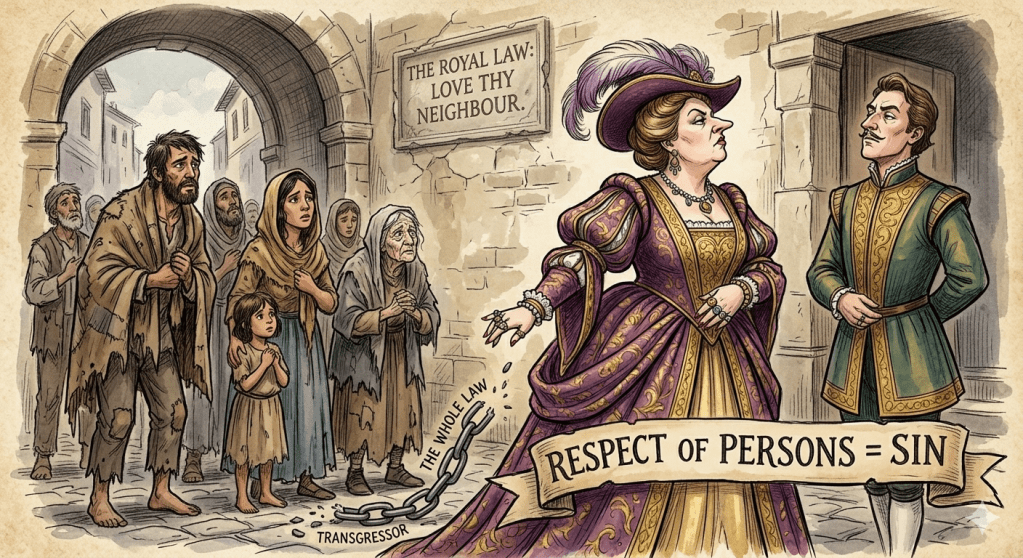
The scenario is this: a wealthy-looking man walks into a group gathering, with gold rings and other fashionable clothing, and is given the best seat, indicating he is respected. A man that is visibly poor walks in, and he is made to sit on the floor, or even stand, not disrespected, but put in a lower status. The question James posses in verse 4 is this: aren’t you acting as an improper judge when your basis for judgement is whether or not someone “looks” to be a good person? You assume the rich person is “better” or more worthy of respect simply because of their bank account, while assuming the poor person is less worthy. In the biblical view, judging someone’s worth based on their wealth is a “distorted” way of thinking.
Verse 5 -7: “5 Hearken, my beloved brethren, Hath not God chosen the poor of this world rich in faith, and heirs of the kingdom which he hath promised to them that love him?
6 But ye have despised the poor. Do not rich men oppress you, and draw you before the judgment seats?” 7 Do not they blaspheme that worthy name by the which ye are called?
Hearken: listen or pay close attention
Blaspheme: means to “speak evil of” or to “slander.”
In this line of questions, James is making a comparison between the two types of people. The poor, having little wealth and fineries here on earth, must rely solely on faith to get them through. They believe that God will provide. This in tern provides them with a seat in God’s heavenly kingdom. Whereas the rich man, with his visible wealth of gold rings, we’re reminded are temporary and will not stand up in God’s kingdom. The rich man also looks down on everyone else, not only the poor but anyone he deems beneath him. A worldly view says that he should be revered for his wealth, but James reminds us that a believer’s wealth will be in heaven. If God has valued the very people you are shunting to the back of the room, then your values are the opposite of God’s. The main point here is this: Why are you sucking up to the people who often mistreat you (the rich), while insulting the very people God has hand-picked to inherit His Kingdom (the poor)?
Verses 8-9: 8 If ye fulfil the royal law according to the scripture, Thou shalt love thy neighbour as thyself, ye do well:
9 But if ye have respect to persons, ye commit sin, and are convinced of the law as transgressors.
The law here is the law Jesus set down in the Gospels. It is the second greatest commandment, which summarizes the moral duty of man towards others. This isn’t to say that the commandments that Moses was given are not of importance either, but that’s another study. If you truly love your neighbor as yourself, you cannot treat one neighbor better than another based on their clothes or wealth. Please remember though, love is very strongly defined in the Bible. It’s not “infatuation” or “lust;” it runs deeper than that. Biblical love means also correction, as you would correct your child if they were doing something wrong. You correct them because you love them. Again, another study for another day.
“Respect of persons” is the KJV way of describing favoritism. Therefore, if we are showing favoritism based on an outward appearance only, then we are committing a sin. Sin, as we know, is against the word of God and the laws that Jesus set down in the gospels. By showing partiality to the wealthy man, you have broken the “Royal Law” of love. Therefore, you aren’t just a “rudely behaved person”; you are a transgressor or a lawbreaker.
Verses 10-11: “10 For whosoever shall keep the whole law, and yet offend in one point, he is guilty of all.
11 For he that said, Do not commit adultery, said also, Do not kill. Now if thou commit no adultery, yet if thou kill, thou art become a transgressor of the law.”
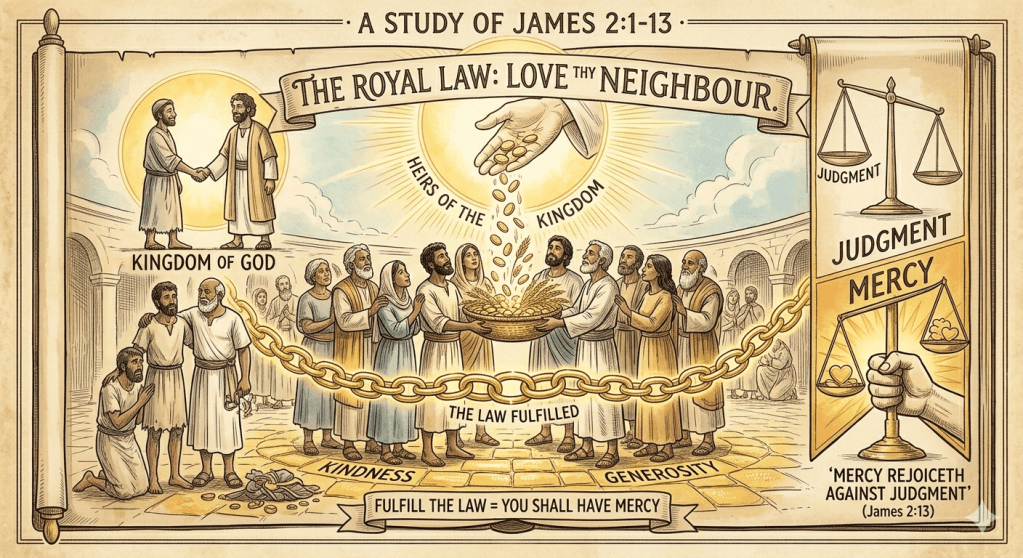
Think of God’s law like a chain, a connection link by link between you and our Heavenly Father. Each link in the chain is a particular law set down by God. If you break a law or a link, the chain fails, and ultimately your connection to God fails. Now there is no difference in the link so the chain, whether they are big or small, just like the laws. You don’t say, “Well, 90% of the links are still holding.” The chain has failed its purpose. In the biblical view, the Law is a single, unified expression of God’s nature. To “offend in one point” (like showing favoritism to the rich) is to rebel against the Authority who gave the entire Law.
In verse 11, James shows this by using two “big” sins to prove the point about “small” sins, like partiality. If the same God forbade favoritism and murder, then showing favoritism breaks the law just as murder does. You are still disobeying. Whether you kill someone or just treat a poor person like they don’t matter, your status changes from “Innocent” to “Transgressor.”
While this sounds incredibly harsh, James is preparing his us for the next two verses (v. 12-13), which talk about Mercy. He is showing that everyone needs mercy because everyone has “broken a link” in the chain.
Verses 12-13: “12 So speak ye, and so do, as they that shall be judged by the law of liberty. 13 For he shall have judgment without mercy, that hath shewed no mercy; and mercy rejoiceth against judgment.”
These two verses are the “grand finale” of James’ argument. After showing how easy it is to become a lawbreaker (by even a “small” sin like favoritism), he offers the solution: Mercy. Usually, we think of “laws” as things that restrict us, but James calls it a Law of Liberty (freedom). This is the law of the New Covenant—where obedience doesn’t come from a fear of punishment, but from a heart changed by God’s grace. “So speak ye, and so do.” James is calling for consistency. Your words (speech) and your actions (conduct) must both be governed by the reality that you will one day stand before God. James issues a sobering warning: “For he shall have judgment without mercy, that hath shewed no mercy.”If you refuse to show mercy to the poor man in your church, you are essentially telling God, “I want to be judged by the strict Letter of the Law.” And as James just proved in verse 10, if you are judged by the strict Law, you will fail. Mercy stands up and “boasts” over that judgment. It doesn’t say the judgment was wrong; it says the debt has been covered.
The Takeaway:
The reason we shouldn’t show favoritism isn’t just because it’s “rude”—it’s because we are all beggars who have received mercy from God. If we’ve been saved by mercy, we have no right to withhold that same dignity and love from others.
Now that James has finished this argument on faith and partiality, he immediately moves into his most famous (and controversial) section: “Faith without works is dead.”
But that’s for another time. Until then, happy reading through every thee and thou.
 Sayeth What?!
Leave a comment